Blog / Architecture
Control who uses AI, what it can do and what it costs, on infrastructure you control.
Artificial intelligence (AI) is spreading across your organization. Business teams use AI assistants to prepare proposals, write marketing briefs, summarize policies and analyze financial data, among many other uses. Developers call models from several providers to build agentic applications. Those agents act across your enterprise systems. Each use creates value, and each raises the same questions. Who is using AI? What are they using it for? Which data does it touch? What does it cost?
AI governance answers these questions. Technology leaders need to enforce organizational AI policy so that AI is used responsibly, in how it is used, what it is used for, which data it touches and what it costs. Governance is not about restricting your users. It sets the boundaries that let them use AI with confidence and streamlines AI use toward organizational goals, so you can approve more of it.
Sovereignty addresses an altogether different question: does your AI stay within your control, with your sensitive data inside your borders? Most organizations today need both. This blog shows how AlchemiStudio, SUSE and NVIDIA come together to deliver sovereign AI that you can also govern.
IT needs control of token cost. Every assistant, agent and application consumes tokens, and spend grows with each new use. Unlimited token spend is no longer a plan. IT needs budgets and limits. Without central controls, spend is hard to predict against budget, hard to cap, and hard to attribute to the team or application responsible.
Technology leaders need to enforce organizational AI policy uniformly. CIOs, CTOs and CAIOs decide which models, data and tools each role may use. They need to apply that policy across every team through role-based access control, so AI use supports organizational goals without sacrificing security.
Technology leaders need to define what agents may do before they let them act. Agents do more than answer questions. They work across enterprise systems and can run multi-step and scheduled workflows, including autonomously and while a person is away. To trust agents with real work, IT needs to control which tools and systems each agent can use, set permissions and action policies, require human approval for sensitive actions, and keep a record of what agents do.
Risk, legal and audit teams need evidence. They must show who did what, under which controls, and which records support that conclusion.
Your AI, your control and your data must stay within your control. Many organizations, especially in regulated industries and the public sector, need proprietary data to stay inside their own borders, and they need the option of privately hosted models and private model endpoints, not only commercial services.
Environments differ. You may run AI in data centers, private clouds, public clouds and you need the same control wherever it runs.
SUSE AI Factory with NVIDIA operates your AI: it gives you a secure place to run it, on infrastructure you control. AlchemiStudio governs it: it gives technology leaders the controls to set organizational AI policy, manage cost and show what happened. Together they deliver sovereign AI that you can also govern.
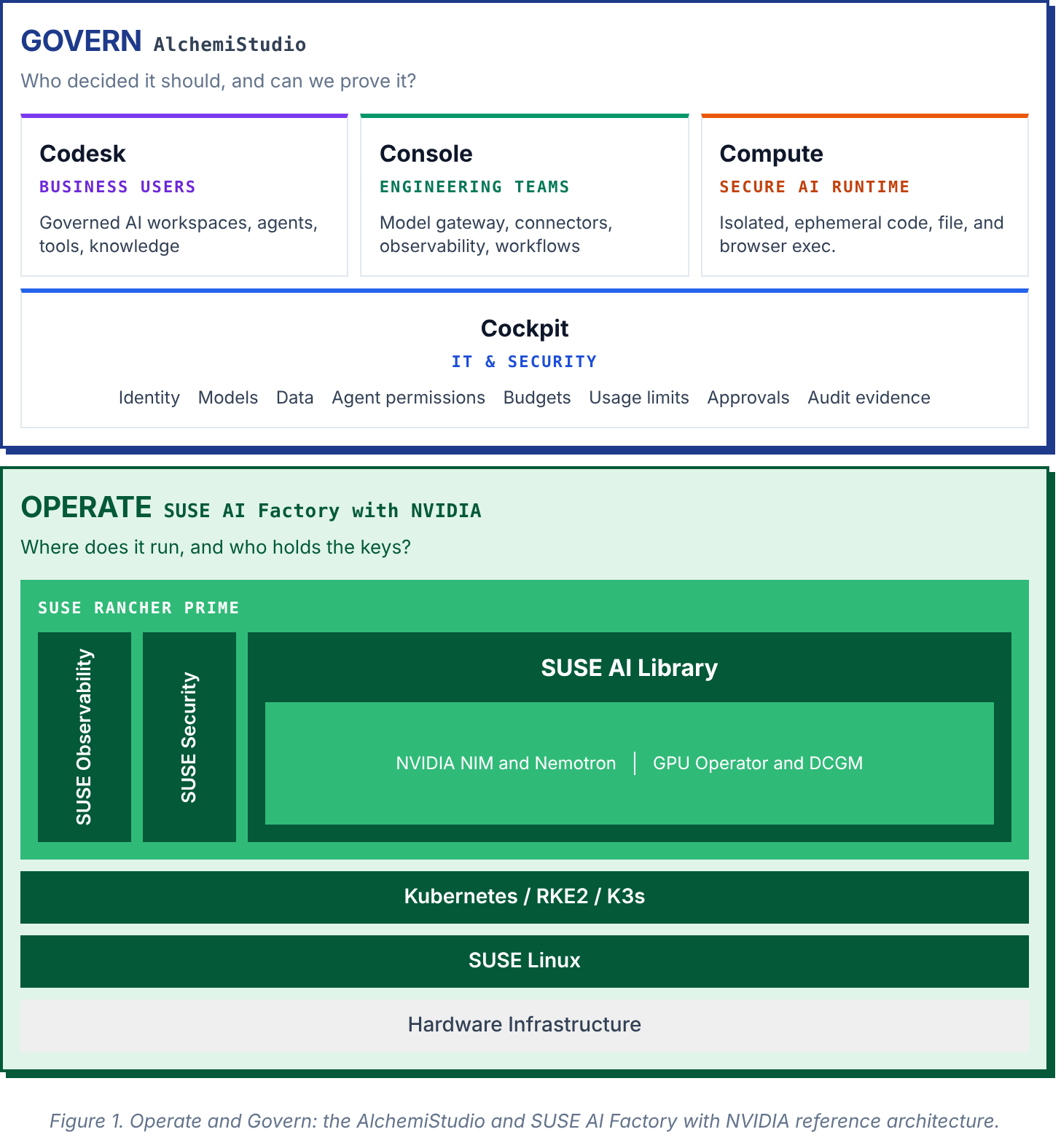
Figure 1. Operate and Govern: the AlchemiStudio and SUSE AI Factory with NVIDIA reference architecture.
Three parts work together:
The reference architecture has two layers. Operate answers “Where does it run, and who holds the keys?” Govern answers “Who decided it should, and can we prove it?”
Your infrastructure. SUSE Linux Enterprise Server or SUSE Linux Micro runs on your own hardware, in your data center, private cloud or edge location. RKE2 or K3s provides Kubernetes, managed by SUSE Rancher Prime, protected by SUSE Security and monitored with SUSE Observability.
Your models. The SUSE AI Library supplies supported AI tools, including NVIDIA NIM and Nemotron. Privately hosted models run on Kubernetes behind private model endpoints, so proprietary data can stay inside your boundary.
Your control layer. AlchemiStudio runs on this foundation, in your cloud, your data center or a disconnected environment. Its model gateway also reaches major commercial model providers, so budgets and access policies cover those requests too, where your policy allows. Your policy sets which models and data classes each team can use, and sensitive workloads can be pinned to in-perimeter or sovereign models.
Your identity, keys, policies and retention settings remain under your control throughout.
AlchemiStudio has four modules. Your organization builds and approves the agents that run on them.
Developers want fast access to the best model for each task. IT wants to know what that costs and to keep it within budget. Cockpit and Console address both.
Technology leaders need to enforce organizational AI policy uniformly, and AlchemiStudio gives them the power to do it. CIOs, CTOs and Chief AI Officers (CAIOs) set the direction. AlchemiStudio enforces it across every team, model and tool on the platform, based on role-based access control (RBAC) and policy, so AI use stays aligned with organizational goals without sacrificing security. Cockpit turns your policy into controls:
Governance of this kind is not about restraining AI use. It sets clear boundaries, so teams move faster within guardrails, and you can say yes to more AI with confidence.
Guardrails and approvals. Guardrails inspect inputs and outputs for personal data, secrets, prompt injection, jailbreak attempts, toxicity and restricted topics. Apply them by user, key, endpoint, or agent. Approval steps and permissions govern what agents may do with tools and data, and AlchemiStudio can stop unauthorized requests and actions that pass through the platform’s controls.
Isolated execution. AlchemiStudio Compute runs agent code, file and browser actions in isolated, ephemeral sandboxes that start in under a second. Each run starts from a fresh, identical state with memory separated between sandboxes, and the sandbox is torn down automatically when the task completes. Hard timeouts stop runaway processes.
Runs wherever you deploy. Compute runs any OCI image in the cloud, on premises or fully air-gapped. SUSE Security adds zero-trust workload protection beneath the platform.
Audit evidence. AlchemiStudio records requests, responses, tokens, cost, latency, routing, guardrail outcomes, tool calls and administrative changes, along with approval records. You can export this evidence to your existing observability tooling. It can help address portions of the governance and regulatory obligations facing organizations in financial services, public sector, healthcare, telecommunications and critical infrastructure.
Here is one example of how the pieces work together:
A sales manager asks a governed agent in Codesk to prepare a proposal for an account.
A developer receives a scoped virtual key that carries approved models and a budget, valid for the period a manager sets, such as the three weeks of a project.
These examples are simplified. AlchemiStudio also handles more complex flows, including multi-step and scheduled workflows with human approval steps, and the same pattern applies across sales, marketing, HR, finance and operations. Talk to us about your scenario.
The table shows how responsibility divides between the people who use AI and the people who govern it.
| Developers and business users | IT and security teams (Cockpit) | |
|---|---|---|
| Models | Use approved models through scoped virtual keys | Set which models each team may use |
| Spending | Work within budgets and usage limits | Configure budgets and limits, and track spend in real time |
| Data and tools | Reach approved knowledge and connections | Decide which data classes and tools each team and agent can reach |
| Agent actions | Delegate tasks to governed agents and respond to approval requests | Define which tools and systems agents may use, and which actions need approval |
| Evidence | Inspect traces and logs for the applications they build | Review audit records, guardrail events and exports |
Ready to see sovereign AI you can govern? Book a demo. Contact Moses Mathuram, Chief Revenue Officer at AlchemiStudio, at moses@alchemistudio.ai, or Martina Ilieva, Lead, AI Partner Ecosystem at SUSE, at martina.ilieva@suse.com.
Download the SUSE AI Factory with NVIDIA and AlchemiStudio Solution Flyer .
Learn more at alchemistudio.ai and suse.com . AlchemiStudio is a SUSE partner and a member of NVIDIA Inception.
Next step
Take this from insight to execution with AlchemiStudio.